UKR
UKR
Delivery and Service, Technologies and Water Quality
What Happens to a Returnable Bottle After Delivery: Washing, Inspection and Reuse
Jul
Have you ever wondered where the bottle goes after the water runs out? Not the one on the single-use shelf at the store, but the one delivered to your home or office. Many people assume it’s simply refilled — and that’s it. In reality, the journey of the container is much longer and more interesting. Let’s walk through it together.
This isn’t a boring factory lecture. It’s the story of what happens between the moment you hand the empty bottle to the courier and the moment it ends up back with you, filled with clean water.
Where the bottle goes after the water runs out
So, the water is gone. The empty bottle is waiting for the next delivery. You hand it to the courier — and most likely forget about it until next time. Which is a shame.
This bottle isn’t thrown away. It goes back to the production facility, where it goes through a whole processing cycle before returning to you. Returnable packaging isn’t just convenient — it’s a huge saving of resources. That’s why manufacturers treat it so carefully.
The bottle’s journey: from your door back to production
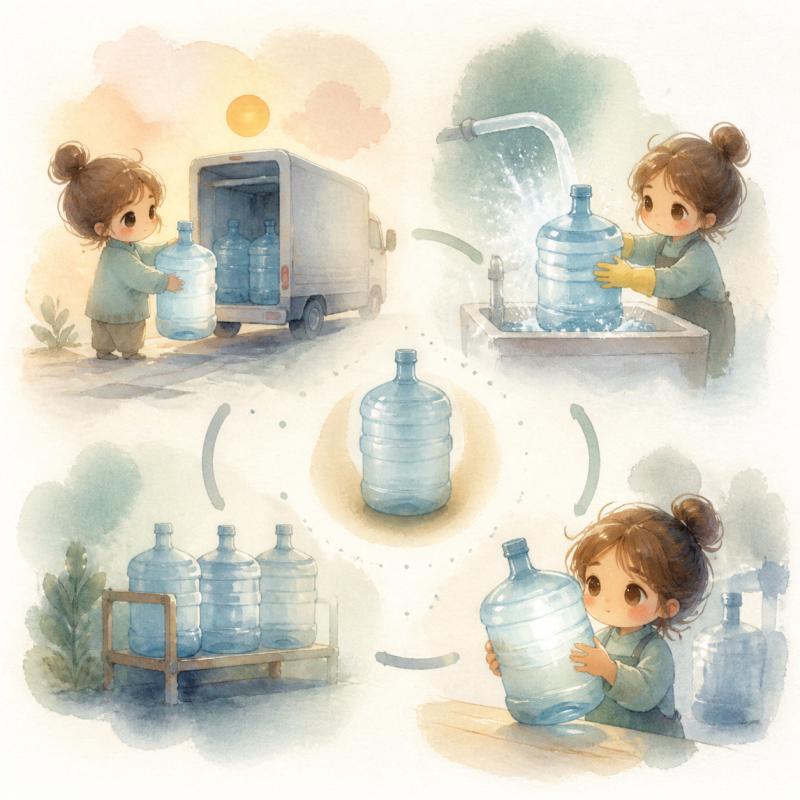
The scheme is simple and refined over years. The courier brings you a full bottle and takes the empty one. Then the empty container goes to the warehouse, and from there — to production.
There, the bottle enters the start of the production chain. And this is where the most important part begins. Because the water can be perfect, but if it’s poured into a dirty bottle, all that work goes to waste.
Washing: why it’s the most important step
A bottle is a reusable item. So its sanitary treatment is a matter of safety, not cosmetics. What ends up in your glass depends directly on how thoroughly the container is washed.
Manual washing is the weak link here. A person can get tired, distracted, or skip an area. That’s why we switched to automatic washing long ago, where the human factor is completely eliminated. We’ve covered why this matters in detail in a separate article: «Benefits of automatic bottle washing in drinking water production lines».
An automatic line washes every bottle just as thoroughly, time after time. No rushing, no missed spots, no “well, looks fine.” This is one of those cases where a machine really is more reliable than a person.
Inspection: what the bottle must pass to return to you
Washing is only half the job. After washing, the bottle goes through an inspection. This isn’t just a quick glance — it’s a check that weeds out containers not fit for reuse.
What gets checked:
- Cleanliness — no leftover traces, odors or foreign particles.
- Integrity — no cracks, chips or damage through which something extra could get in.
- The neck and cap — to make sure the seal is airtight.
A bottle that fails the inspection doesn’t go back into circulation. That’s the honest and reliable way.
Reuse: how many times and why it’s normal
Maybe a thought crossed your mind: “Doesn’t the bottle wear out? Isn’t it harmful to drink from reusable packaging?” I get it, it’s a fair question. But it’s important to distinguish between two things here.
A returnable bottle is not the same as a plastic bottle from the store that you buy with water and throw away. Returnable containers are made sturdy, and they’re designed for repeated use. What matters is that every processing cycle is done properly.
That’s why what comes first isn’t “how many times” but “how it was processed.” One thoroughly washed and inspected bottle is safer than a new one that no one checked. So reusable packaging isn’t a compromise — it’s standard practice.
Ecology: why returnable packaging is a win for the planet
Now, about something people often overlook. A returnable bottle isn’t just convenient — it’s a serious contribution to the environment. Every time a bottle comes back and is used again, we don’t produce new plastic packaging.
Less plastic means less waste, fewer resources spent on production, and less strain on the planet. This is one of those rare cases where convenience and ecology go hand in hand, rather than arguing with each other.
We try to think about the environment at every step of production. You can read more about it in our article: «Ecology in every drop: how Cascade helps to preserve nature».
In short: what happens to the bottle after delivery
- You hand the empty bottle to the courier.
- It returns to the production facility.
- The bottle goes through automatic washing without human involvement.
- It’s checked for cleanliness, integrity and airtightness.
- Approved containers are refilled with clean water.
- The bottle returns to you — and the cycle repeats.
How we can help
We, Cascade, produce and deliver purified drinking water in Odesa and the region. Our packaging is returnable, and every cycle goes through automatic washing, inspection and control. So when you order water from us, you know the bottle you drink from has gone through the full treatment journey.
If you’d like to see it for yourself — just place an order. And if you’re curious about how to store water properly at home, check out our guide: «How to properly store drinking water».